You can't out-target weak positioning.

Rishabh Rastogi
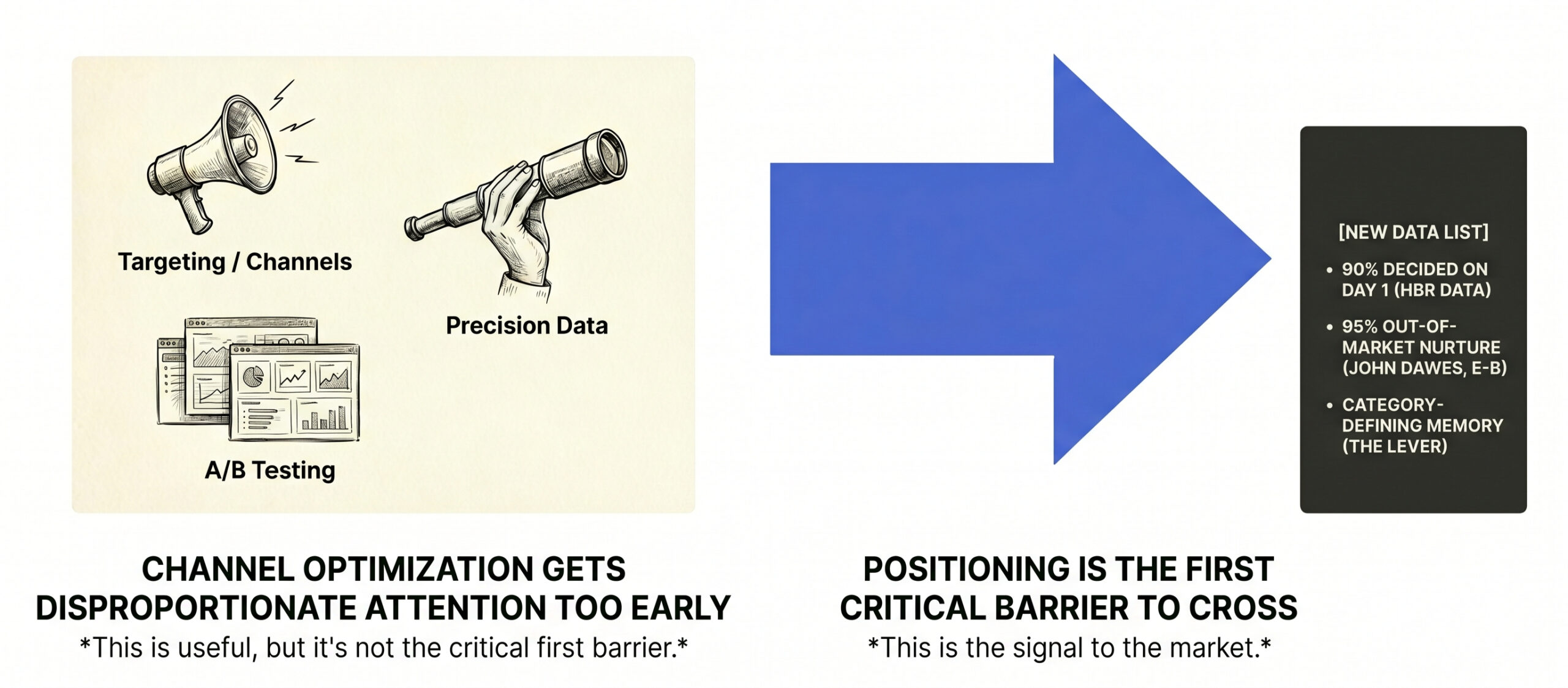


Walk into any B2B marketing team today and you’ll see the same theatre. Someone is pulling up the dashboard. Someone is debating intent data. Someone is A/B testing a subject line and posting a Slack victory lap when it wins by 0.3%. Someone – almost always – is rebuilding the HubSpot scoring model. Again.
You can sit in those meetings for a year and never once hear anyone ask the question that decides everything:
Are we actually saying anything worth hearing?
Let’s stop pretending this is a marketing problem. It isn’t. It’s a leadership failure, and the loudest culprits are usually founders who have never built a brand in their lives. They want pipeline numbers to twitch by Friday. They want to point at a dashboard and feel that something – anything – is happening. They will write a $50,000 cheque for another LinkedIn ad set before they will sit through a single afternoon of positioning work, because the first looks like motion and the second looks like talking.
It is not talking. It is the work. And the refusal to do it is the most expensive habit in modern B2B.
The data is brutal.
Three numbers should end the channel-versus-positioning debate permanently. They don’t, because most B2B leaders have never bothered to read them.
One. Professor John Dawes at the Ehrenberg-Bass Institute, working with the LinkedIn B2B Institute, established the 95/5 Rule in 2021. At any given moment, only 5% of B2B buyers in a category are in-market. The other 95% are out-of-market. They will not click your ad. They will not book a demo. They will not respond to your perfectly-personalised cold email. They will, eventually, buy from someone. That someone is not chosen at the moment of purchase. It is chosen long before.
Two. When those 95% finally do enter the market, Gartner’s 2024 research shows they spend only 17% of their total buying time talking to vendors: and that 17% is split across every vendor they consider. Which means more than 80% of the B2B buying journey happens inside the buyer’s head, with no vendor in the room.
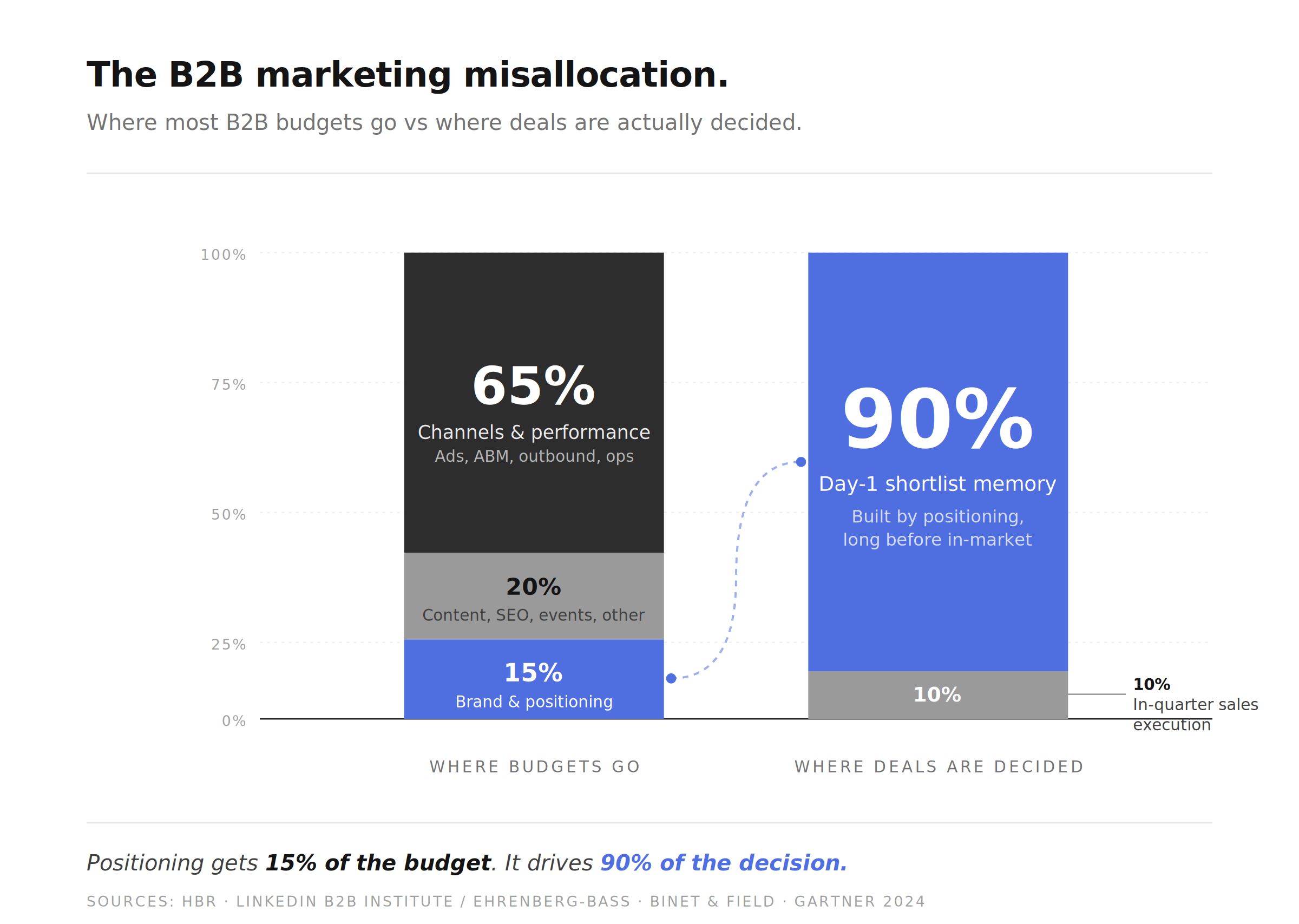
Three. And what is the buyer doing inside their head for those months and years? Building a shortlist. Harvard Business Review research, cited extensively by LinkedIn’s B2B Institute, shows that 80–90% of B2B buyers walk into the buying process with a pre-formed shortlist – and 90% of them ultimately choose a vendor from that Day-1 shortlist.
Read that one more time. Nine out of every ten B2B deals are decided before a single sales conversation. The decision is built on what the buyer remembers about your category; which is built entirely on what you said to them, to all 95% of them, back when they weren’t shopping.
Yet most B2B marketing teams allocate 60–70% of their budgets to performance and channel work. Brand and positioning gets whatever is left over, typically 10–20%. Binet and Field’s B2B effectiveness research, run with the LinkedIn B2B Institute and now the most-cited body of effectiveness work in the category, suggests the optimal split is closer to 50/50.
So here is what we are actually doing. We are pouring most of the marketing budget into reaching the 5% in-market today, and almost nothing into what we say to the 95% who are quietly deciding our future deals while we obsess over click-through rates.
If this were any other business function, we would call it malpractice.
History has been screaming the lesson.
The companies that have broken out of crowded B2B markets in the last twenty years did not do it through channel optimisation. They did it through positioning. Every time. The pattern is so consistent it should embarrass anyone still arguing the opposite.
HubSpot, 2006. Brian Halligan and Dharmesh Shah walked out of MIT into a market dominated by Eloqua and Marketo. They had no chance in a head-to-head feature war and they knew it. So they refused to fight one. They coined a category – inbound marketing – named a clear enemy in outbound marketing, wrote the book, ran HubSpot Academy to train an entire generation of marketers to identify as “inbound marketers”, and let their competitors keep optimising channels inside a category HubSpot had already defined. By 2024, HubSpot was a $20B+ company with 200,000+ customers and over $2B in ARR. The bet that built that wasn’t a better SEO playbook. It was a positioning move so audacious that it reframed an entire industry.
Drift, 2014. David Cancel and Elias Torres entered an already-commoditised live chat market dominated by Intercom and a long tail of vendors. They refused the feature war too. They named a category – conversational marketing – wrote the book, evangelised the term relentlessly, and within two years had forced HubSpot, Intercom, and Salesforce to all reposition around the language Drift had set. Dave Gerhardt, Drift’s marketing lead, said it plainly: “The idea didn’t really take off until we gave it a name.” Drift went from a tiny chat tool to 50,000+ customers and a category-defining brand. Their competitors had bigger budgets and more channels. They lost anyway, because they were optimising channels inside a category Drift was already naming.
The pattern is not subtle. The companies that win B2B categories are the ones that bet on positioning while their peers bet on channels. Everyone in B2B has access to this history. Almost nobody acts on it.
Why nobody learns the lesson.
Three reasons. All three are operating at once inside almost every B2B company reading this.
Channel work is legible. Positioning is not. Channel work produces dashboards. Pipelines. CTR curves. Cost-per-lead reports. It looks like work because it generates data, and data is what leadership has been trained to mistake for progress. Positioning produces sentences. It produces a half-day workshop. It produces a slightly different way of describing the company. The output is verbal and intangible, and verbal intangible outputs do not get budgeted in companies that have traded judgment for dashboards. April Dunford has spent a decade making this point: most teams use a “positioning statement” — the fill-in-the-blank Mad Lib — to do positioning. The result lives in a deck nobody opens after the offsite. We have built an entire profession around treating the highest-leverage work as a document instead of a discipline.
Positioning is uncomfortable. Channels are not. Getting positioning right means admitting the current version was wrong. The founder has to admit the narrative they fell in love with is off. The marketer has to admit they’ve been amplifying that wrong narrative for months. The sales team has to relearn the pitch they were already comfortable delivering. Every single person in the building loses face in some small way. Almost no leadership team has the stomach for that conversation, so they don’t have it. They optimise channels instead, because optimising channels lets everybody keep believing they were right all along.
AI is making it worse. In 2026, AI is making channel work cheaper, faster, more measurable, more automated than it has ever been. Sequences write themselves. Ad copy auto-generates. Scoring models tune themselves. The gravitational pull toward channel optimisation has never been stronger – at the exact moment the data is screaming that the consequential lever has shifted further away from it than ever. And AI tools, by default, produce generic positioning. Ask any frontier model for “five positioning options for a B2B SaaS that does X” and you’ll get five interchangeable bullets your competitors could also generate. The companies racing to AI-automate every channel while leaving their positioning untouched are accelerating toward the exact wall the data warned them about.
We talk endlessly about product-market fit. We test it. We iterate it. We obsess over it. We almost never talk about product-positioning-market fit – whether the way we describe our product is the way our market would describe it back. That gap, when it exists, is where money goes to die. It is invisible on every dashboard a B2B leader will ever look at. Which is precisely why nobody fixes it.
The bottom line.
You cannot out-target weak positioning. You cannot out-spend it. You cannot out-automate it. You cannot out-AI it.
The buyer’s brain is the bottleneck. And the buyer’s brain doesn’t respond to better targeting. It responds to remembering you.
If you are not memorable, you are not on the shortlist. If you are not on the shortlist, no amount of channel work will save you. Not your ABM platform, not your intent data, not your six-figure agency retainer, not the AI tool you bought last quarter.
The work isn’t channels. The work was always positioning. The channels are just delivery vehicles. Nobody serious builds delivery vehicles before deciding what they’re delivering.
We have spent a decade pretending otherwise. The data has spent a decade telling us we are wrong. At some point, the industry is going to have to listen.